



n November 4, 1922, in the Valley of the Kings near Luxor, the British archaeologist Howard Carter uncovered the first steps of a staircase, buried in the sand, that led to the tomb of Tutankhamun. Three weeks later, on November 26, Carter made an opening in the door that sealed the corridor to the pharaoh’s burial chamber. Squinting in the candlelight, he could make out a treasure trove of objects in the half-darkness: “Presently, details of the room emerged slowly from the mist, strange animals, statues and gold – everywhere the glint of gold,” he wrote in his notes. Asked by Lord Carnarvon “Can you see anything?”, Carter famously replied: “Yes, wonderful things!”
Imagine for a moment the importance of Carter’s discovery in this fragile era. “It will surpass in wealth and interest any other single discovery in the history of Egyptology,” foresaw the Bulletin of the Metropolitan Museum of Art in its January 1923 issue. In Paris, it would have a transformative influence on the decorative arts. This encounter between the ancient and the new proved particularly fruitful, with figures in profile, stylised lotus blossom, scarabs, hieroglyphs and geometric patterns appearing on furniture, wallpaper, jewellery, even clothes. The New York Times of February 7, 1923 reported that “business men all over the world plead for designs for gloves, sandals and fabrics in the Egyptian mode.” The stylised lines of Egyptian art perfectly echoed the burgeoning Art Deco style. Meanwhile, combinations of lapis lazuli, turquoise, carnelian and gold inspired — and continue to inspire — jewellers, inviting them to explore new harmonies of colour.

Ancient Egypt arrives at Place Vendôme
Van Cleef & Arpels embraced this trend with particular flair. Between 1923 and 1924, the house produced several pieces in the reigning Egyptian style. One of these remarkable creations, the Egyptian Pattern bracelet (1924), was shown at the MAK Museum in Vienna as part of the Glanzstücke exhibition, which ran until October 2026. Against a backdrop of pavé diamonds on platinum, miniature scenes of animal and human figures inspired by ancient Egyptian civilisation come to life in a delicate arrangement of rubies, emeralds, sapphires and onyx. The various designs are recorded on product cards from 1923 and 1924. Conserved in the Van Cleef & Arpels archives, they also featured in the exhibition.
Bracelets and brooches from this period sought not to slavishly reproduce archaeological finds, instead extracting motifs and decorative principles which were then reimagined in the aesthetic language of 1920s Parisian jewellery.

Jewels for an Egyptian princess
A few years later, Egypt and Van Cleef & Arpels were reunited, thanks to the house’s relations with the Egyptian royal family. The patrimonial collection conserves a stunning Collerette necklace from 1929, set with diamonds and teardrop emeralds suspended from a geometric Art Deco structure in platinum. Formerly owned by Her Royal Highness Princess Faiza of Egypt, it was one of the centrepieces of the exhibition in Vienna.

Later, in the 1980s, ancient Egyptian iconography inspired Van Cleef & Arpels once again, this time for the Osiris parure (1989). The torque necklace and accompanying jewels pair yellow gold and white gold with chrysoprase, lapis lazuli, onyx, coral and diamonds. Its surface is set with ornamental stones in geometric motifs that frame two stylised birds. The parure is named after Osiris, an important ancient Egyptian deity, though it is the interplay of colour and shape that truly brings this inspiration to the fore.
Fascinating Egypt, a new chapter
In 2026 Van Cleef & Arpels has dedicated an entire high jewellery collection to Egypt. Fascinating Egypt comprises 180 pieces and was more than four years in preparation. In the words of Catherine Rénier, President and CEO of Van Cleef & Arpels: “For many years, the Maison Van Cleef & Arpels, so inspired by Egypt in the 1920s, has wished to prolong the story and present its own vision of this ancient heritage.”
This ambitious collection explores Egyptian civilisation through its art, its landscapes, its ornamentation, its mythology and its symbols, all the while connecting them with the house’s history and savoir-faire.
Precious stones mix with ornamental stones; diamonds and precious gems join coral, turquoise, malachite, mother-of-pearl and onyx in combinations that echo the rich colour palette of Egyptian adornments. Ancient motifs are enlarged, softened or recomposed, while the contours of certain pieces are informed by pharaonic jewels.

The Silhouette Divine pendant/clip illustrates this exploration of the human form. A woman’s profile is rendered in turquoise, set with a diamond eye. Dark onyx hair and a headdress of coral, malachite, white mother-of-pearl, onyx and diamonds recall depictions of ancient Egyptian figures. These ornamental stones play an essential role, their coloured surfaces forming the building blocks of the design.
The Paysage Royal bracelet looks to another aspect of the ancient Egyptian lexicon. Set in yellow gold and white gold, a blanket of emeralds, rubies, blue and pink sapphires, onyx and diamonds paints a multicoloured fresco that converges towards an Eye of Horus, a protective symbol. This cuff bracelet echoes others that Van Cleef & Arpels was making in 1923 and 1924.

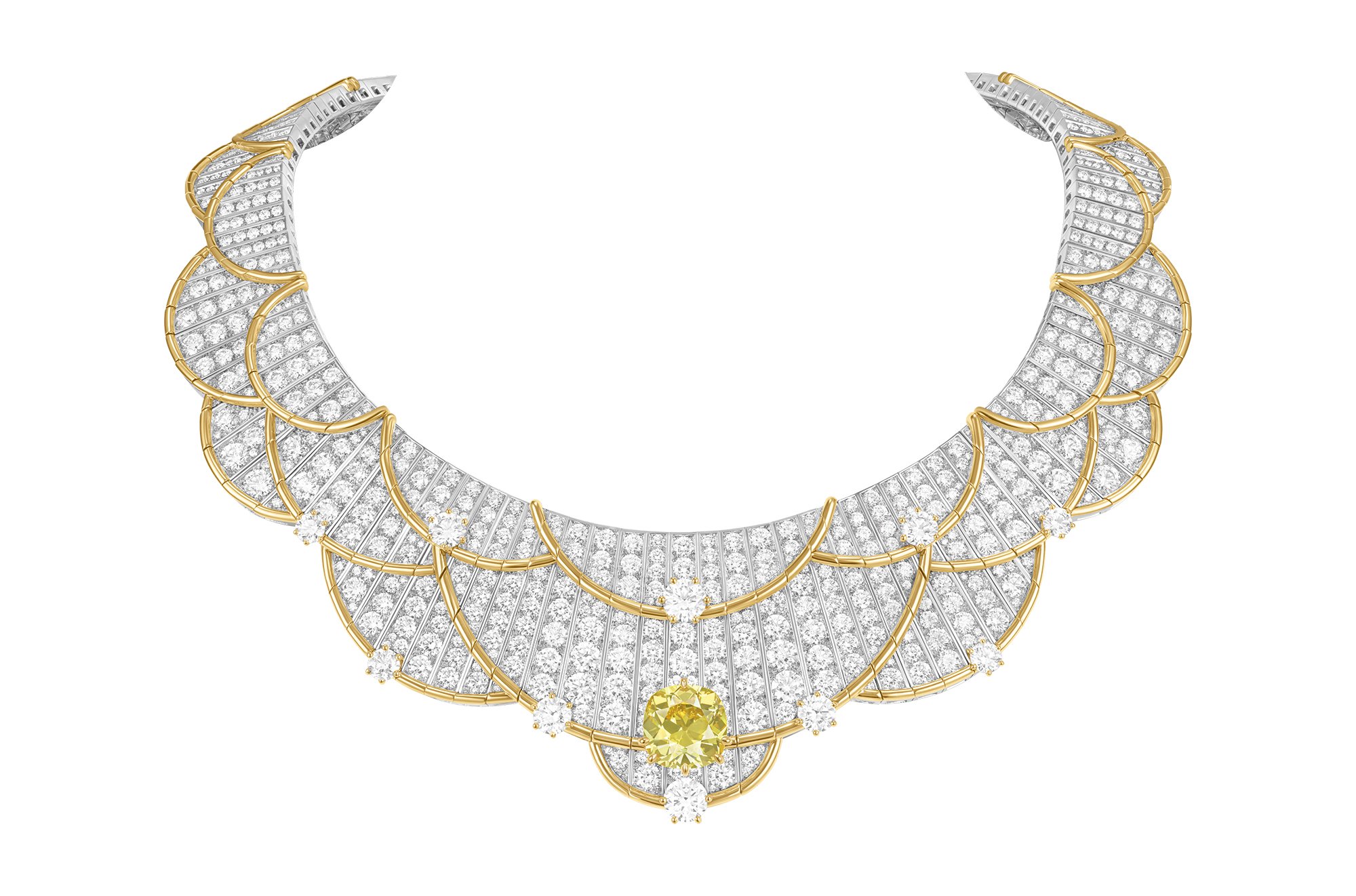
The shape of the Beauté Légendaire necklace mirrors that of ancient Egyptian jewels. Rows of diamonds, hemmed with yellow gold scallops, recall the wesekh ceremonial collars. The composition is anchored by a 10.02-carat Fancy Vivid Yellow diamond centre stone that brings a splash of colour to a necklace bathed in the radiance of diamonds.
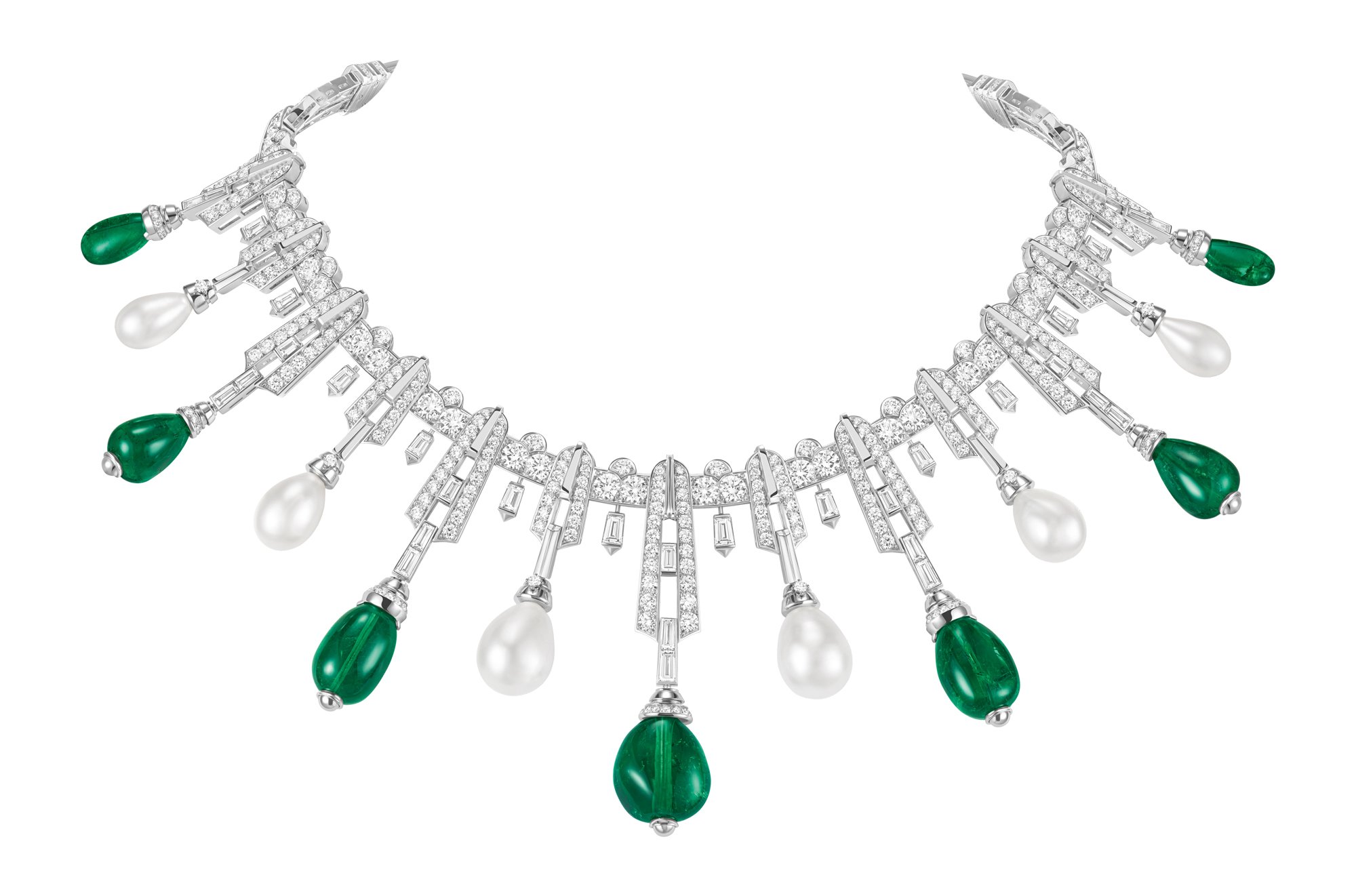
The Princesse du Nil necklace takes its inspiration from Princess Faiza’s 1929 Collerette necklace. Ten Colombian emerald drops totalling 107.37 carats, interspersed with seven white natural pearls, radiate from a diamond-set collar to compose a stunningly beautiful necklace whose clasp extends into a detachable motif.
Other pieces look to deities and to celestial phenomena. The Muse Protectrice clip, in white gold, yellow gold, sapphires and diamonds, portrays a female figure holding attributes borrowed from Egyptian religious iconography, while the Éclipse de la Lune clip takes shape around a 2.29-carat black Australian opal. Flashes of blue and green contrast with the diamonds and yellow gold accents. The house has drawn on a vast repertoire and this is reflected in the diversity of the 180 jewels in the collection. The forms, the chromatic associations, the silhouettes and the themes are those of ancient Egypt but they are interpreted according to the jeweller’s own aesthetic preferences and techniques.

A living heritage
More than a century separates the Egyptian Pattern bracelet from the Fascinating Egypt creations. During this time, the jeweller’s path has met that of the Egyptian royal family and given rise to multiple creative explorations of Egyptian iconography. The 2026 collection continues this journey, without seeking to reproduce designs from the past. Instead, it draws on Van Cleef & Arpels’ archives and the house’s artistic legacy to imagine contemporary interpretations of motifs that have endured through thousands of years. A precious bridge between eras, cultures and styles.


