



ach creation within the collection is a singular interpretation, empowered by that same invisible, untamed force that has driven history’s greatest masters to transform intuition into form—bringing to life masterpieces of eternal beauty. From artist to artisan, creation becomes a journey defined by knowledge, savoir-faire and dedication. The jewel thus becomes the tangible expression of an idea, where every detail is meticulously curated to achieve a perfect balance of light, form and movement.
The collection draws its origins from studying the most distinctive elements of eight masterpieces: the mesmerizing magnetism of Caravaggio’s Medusa; the triumphant awakening of nature in Botticelli’s Allegory of Spring; the primordial force of Katsushika Hokusai’s The Great Wave off Kanagawa; the contemplative stillness of Jeong Seon’s A Leisurely Cat in Autumn; the expressive rigor of Wassily Kandinsky’s Gray Form; the ecstatic longing of Klimt’s The Kiss; the infinite light of Claude Monet’s Water Lilies; and the textural vibrancy of Vincent van Gogh’s Sunflowers.
Balancing creative flair and technique, “Arte Maestra” draws upon the genius that animates the most significant works in the history of art—reinterpreted through Damiani’s excellence—standing as a testament to over a century of tradition shaped by passion, craftsmanship and beauty.
Floréa is a High Jewelry masterpiece that transforms the symbolic richness and poetic beauty of Sandro Botticelli’s Allegoria della primavera* (Allegory of Spring) into precious form, taking inspiration from the celebrated work that inspired its creation.
Just as the garland of Flora — goddess of springtime in Roman mythology and one of the central figures in the painting — bursts into bloom, every element of the jewel appears to blossom from a meadow of magnificent emeralds, shimmering in two distinct shades. The eye is drawn to elegant daisy motifs crafted in white gold and diamonds, engaged in a continuous dialogue with other precious flowers sculpted in white, yellow and pink gold and adorned with multicolored sapphires and vivid rubies.
The result is a masterpiece of absolute harmony — reminiscent of Botticelli’s art — rendering the ephemeral beauty of nature eternal.
Painted around 1482 in tempera on panel, Allegoria della primavera (Allegory of Spring) is one of the most celebrated masterpieces of the Italian Renaissance. The work presents an allegory of the renewal of nature and the triumph of love through classical mythology, bringing together figures such as Flora, the Three Graces and Venus, who move gracefully across a flower-strewn meadow against a backdrop of orange and laurel trees. The painting exemplifies the defining characteristics of Botticelli’s art, including his pursuit of ideal beauty and harmony. It also reveals his extraordinary mastery of drawing, evident in the fluid, sinuous forms of the figures and the meticulous depiction of countless species of flowers and plants.
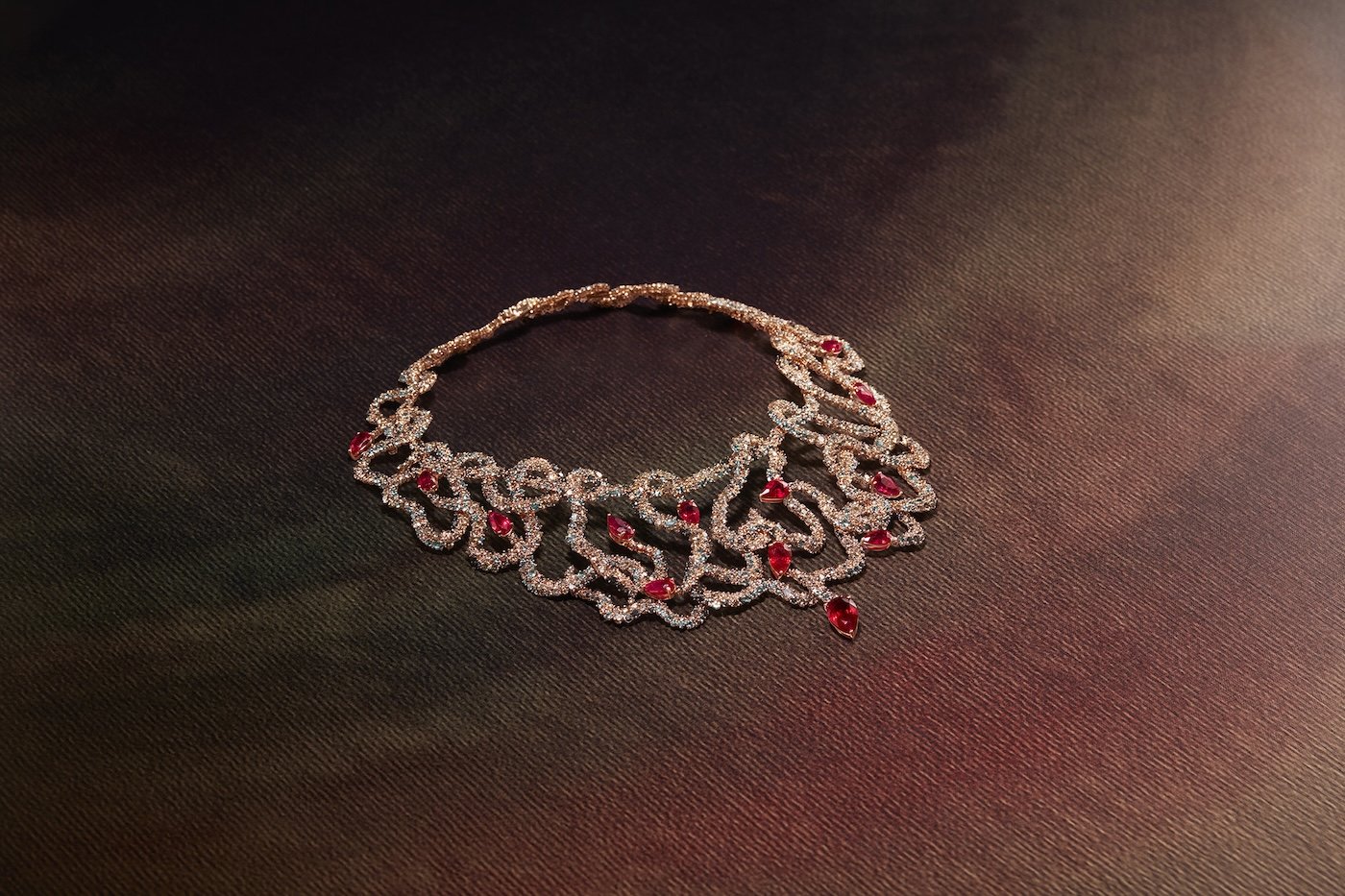
Inspired by Caravaggio’s celebrated Rotella con la testa di Medusa* (internationally known as Medusa), Malìa is a High Jewelry necklace in which tension, movement and mystery find new form. The creation reinterprets the painting’s most distinctive elements — the entwined serpents and the expressive intensity of the Gorgon’s gaze — through sculptural compositions that captivate the eye, suspended between fascination and disquiet.
The necklace features an intricate structure with sinuous serpent-like forms sculpted in pink gold and embellished with alexandrites, black and brown diamonds, while pear-cut rubies define their striking heads. At its center shines a magnificent Burmese Pigeon’s Blood ruby of over 6 carats that enchants with its vivid red hue.
Malìa is a true work of jewelry art instilled with an irresistible enchantment, amplified by the dialogue between the alexandrites and the rubies. Their ever-changing reflections evoke the dramatic contrasts of Caravaggio’s chiaroscuro.
Created around 1598 and commissioned by Cardinal Del Monte for the Medici family, the painting depicts the head of the Gorgon Medusa — the mythical creature with serpent hair whose gaze could turn anyone to stone — at the very instance of her decapitation by Perseus. Caravaggio painted the image in oil on canvas mounted onto a convex ceremonial shield, transforming a classical myth into a work of extraordinary Baroque art through the dramatic realism of Medusa’s expression.
En-Plein-Air portrays the atmosphere and the interplay of light and reflections immortalized by the French master Claude Monet in his celebrated Water Lilies series into High Jewelry.
Crafted in white gold, this majestic necklace evokes the image of a tranquil pond on a still day, where water lily leaves and blossoms appear to float effortlessly in perfect harmony. At the heart of this masterpiece shines a magnificent Colombian emerald of over ten carats, distinguished by its captivating Vivid Green Muzo color, a precious metaphor for the depth of the water. Around this extraordinary gem, the petals of water lilies entwine, adorned with brilliant-cut diamonds and suspended among multicolored sapphires and other diamonds.
En-Plein-Air draws the eye with its rich chromatic harmony, celebrating the ever-changing beauty of nature.
Painted between the late 1800s and the 1920s, Water Lilies* is one of the most celebrated pictorial cycles in the history of modern art. Executed in oil on canvas, these works depict the pond in Claude Monet’s garden at Giverny. Monet uses this subject to explore the changing effects of light and color upon the water’s surface, an exploration that gradually dissolves the landscape, giving way to a freer and more vibrant painting technique.
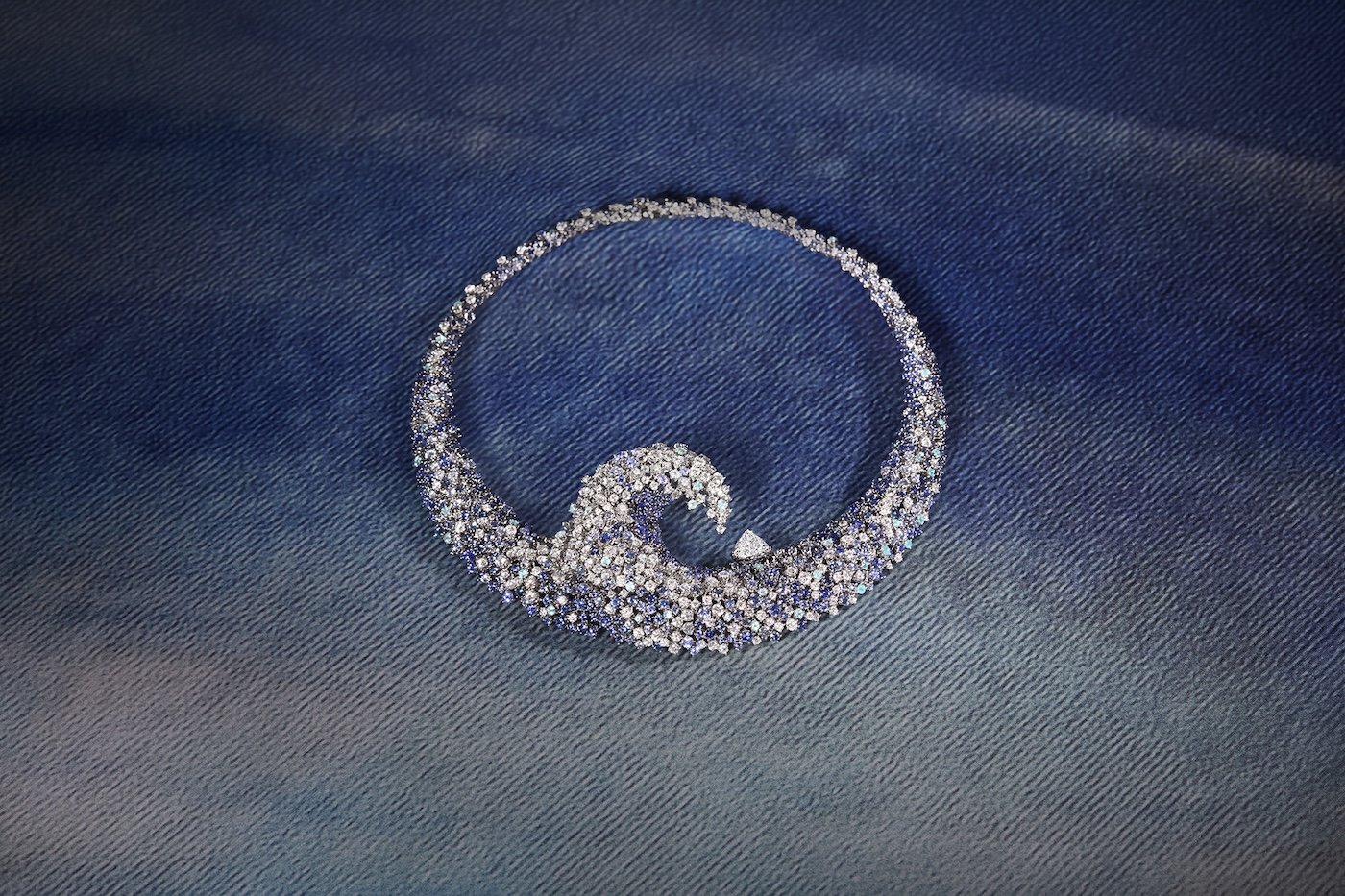
Impetuosa is a High Jewelry masterpiece sculpted by the Maison’s master goldsmiths, drawing inspiration from the overwhelming energy of The Great Wave off Kanagawa* by the Japanese artist Katsushika Hokusai. The creation captures the precise moment when the wave, having reached its crest, begins its descent towards the shore, preserving the suspended tension that defines the original work.
Crafted in white gold, the necklace is adorned with an extraordinary pavé of blue and light blue sapphires, Paraiba tourmalines and diamonds — all brilliant-cut — recreating the depth and movement of the water. The gemstones are meticulously arranged in tonal gradients, progressing from deeper shades at the base to more luminous hues at the crest. Beneath the wave’s peak emerges a certified 3-carat trilliant-cut diamond, a subtle reference to Mount Fuji, visible in the original composition.
Impetuosa is a sublime creation that evokes the dramatic force of nature, capturing one of its most powerful and awe-inspiring moments.
Painted between 1830 and 1831, The Great Wave off Kanagawa forms part of Hokusai’s celebrated series Thirty-Six Views of Mount Fuji. The composition depicts a towering wave crashing over fishermen’s boats, while Mount Fuji stands immovable in the distance. Hokusai transforms a natural phenomenon into an image of overwhelming power, elevating Japan’s sacred mountain into a symbol of permanence amidst the turbulence of the sea. Blending the stylized elegance of Japanese artistic tradition with Western innovations in perspective, the work has become one of the most recognizable masterpieces in the history of world art.
Inspired by the eternal embrace of the lovers portrayed in Gustav Klimt’s The Kiss, Estasi is a High Jewelry masterpiece that reinterprets some of its distinctive elements, such as the use of the color gold and mosaic-like compositions.
This truly extraordinary necklace captivates through its remarkable structure — evocative of a sophisticated work of design — in which yellow gold “tiles”, adorned with baguette-cut diamonds, onyx inserts and brilliant-cut diamonds, alternate with circular elements embellished with rubies. At the heart of the creation stands a captivating cushion-cut spinel of over seven carats, distinguished by its vivid orangy red hue.
In Estasi, Klimt’s dreamlike universe is transformed into precious, tangible matter, creating a truly distinctive representation of craftsmanship and creativity.
Painted between 1907 and 1908 in oil and gold leaf on canvas, The Kiss is one of Gustav Klimt’s most celebrated masterpieces. The painting is widely regarded as one of the defining works of his renowned “Golden Phase”, combining figurative elements with abstraction through the depiction of the lovers’ bodies and the richly decorative geometric motifs adorning their garments. This fusion highlights one of the Austrian painter’s most distinctive artistic pursuits: the search for ideal beauty achieved through ornamentation and color.
Inspired by A Leisurely Cat in Autumn by the Korean artist Jeong Seon, the Impressioni d’Autunno necklace transforms the harmony of the painting into an exquisite High Jewelry creation. Organic forms and warm tones evoke the suspended tranquility of the autumn season, where every element has been meticulously crafted to achieve perfect visual balance.
Pink gold leaves are arranged one after another to form a necklace that stands out for its lifelike details: brown diamonds add depth to its burnished lines, tsavorites in two shades of green mimic the subtle variations found in nature, while five pink cabochon-cut corals add a touch of subtle energy.
The apparent simplicity of the landscape depicted in the artwork is transformed into an expressive language in which proportion, elegance and craftsmanship converge, giving life to a masterpiece that transcends time.
Painted during the Joseon Dynasty, this work depicts a cat reclining with effortless elegance within a serene autumnal landscape. Executed in color and ink on silk, the painting reflects the aesthetic values of classical Korean art, where tranquility and beauty are inseparable. Through the contemplative observation of nature and the attentive rendering of detail, Jeong Seon creates a composition defined by balance, serenity and a reassuring sense of stillness.
Inspired by the abstract language of Gray Form by Wassily Kandinsky, Pentagramma translates one of the defining principles of the Russian painter’s artistic vision into precious form: the idea of visual art becoming music.
At the heart of the creation lies an elegant detachable pendant/brooch in white gold, conceived as a geometric composition in which lines, volumes and intervals intertwine, evoking the structure of a musical stave. Within this framework, the gemstones — seven magnificent fancy-color diamonds in a variety of cuts, together with brilliant-cut colorless diamonds — are arranged like musical notes, creating a dynamic yet perfectly balanced interplay of forms. Crafted in white, yellow and pink gold, the necklace is adorned with a sequence of brilliant-cut colorless diamonds, punctuated at measured intervals by six additional fancy-color diamonds in pear and marquise cuts.
Pentagramma is a High Jewelry masterpiece in which every element resonates with precision, like the notes of a timeless symphony.

Painted in 1922 in oil on canvas, Gray Form belongs to Kandinsky’s Bauhaus period and represents an advanced stage in his exploration of abstraction, in which all references to objective reality are abandoned in favor of an inner dimension. The artist creates a composition of forms, lines and fields of color that eloquently expresses his artistic philosophy: a vision in which shapes and colors become autonomous vehicles of expression, transcending the mere representation of the object.
Inspired by Vincent van Gogh’s Sunflowers, Radiosa transforms the vitality of this celebrated masterpiece into an extraordinary High Jewelry creation.
A majestic white gold and diamond choker embraces a detachable yellow gold pendant/brooch, evoking a sunflower in full bloom. At its heart radiates the warm hue of a magnificent fancy yellow-brown emerald-cut diamond of over 21 carats, elevated by a carpet of brown diamonds and encircled by a corolla of fancy yellow diamonds. Together, these precious gemstones capture the chromatic intensity that defines the visual language of the Dutch master.
Radiosa is a testament to extraordinary craftsmanship, capturing the same expressive power as the masterpiece that inspired it: luminous, richly textured and unforgettable.

Painted between 1888 and 1889 in Arles (France), the celebrated Sunflowers series highlights some of the most distinctive characteristics of Vincent van Gogh’s art, including his intense use of yellow, vibrant brushwork, and the pursuit of a powerful visual expression. Considered among the most iconic works of the Post-Impressionist movement, these paintings explore the relationship between light, color and the vitality of nature through the recurring motif of the sunflower and the artist’s impasto technique, which imbues the compositions with remarkable energy and emotional intensity.
Inspired by Vincent van Gogh’s Sunflowers, Radiosa transforms the vitality of this celebrated masterpiece into an extraordinary High Jewelry creation.

A majestic white gold and diamond choker embraces a detachable yellow gold pendant/brooch, evoking a sunflower in full bloom. At its heart radiates the warm hue of a magnificent fancy yellow-brown emerald-cut diamond of over 21 carats, elevated by a carpet of brown diamonds and encircled by a corolla of fancy yellow diamonds. Together, these precious gemstones capture the chromatic intensity that defines the visual language of the Dutch master.
Radiosa is a testament to extraordinary craftsmanship, capturing the same expressive power as the masterpiece that inspired it: luminous, richly textured and unforgettable.
Inspired by Vincent van Gogh’s Sunflowers, Radiosa transforms the vitality of this celebrated masterpiece into an extraordinary High Jewelry creation.
A majestic white gold and diamond choker embraces a detachable yellow gold pendant/brooch, evoking a sunflower in full bloom. At its heart radiates the warm hue of a magnificent fancy yellow-brown emerald-cut diamond of over 21 carats, elevated by a carpet of brown diamonds and encircled by a corolla of fancy yellow diamonds. Together, these precious gemstones capture the chromatic intensity that defines the visual language of the Dutch master.
Radiosa is a testament to extraordinary craftsmanship, capturing the same expressive power as the masterpiece that inspired it: luminous, richly textured and unforgettable.


