



Byzantine mosaic, a silver bowl from the Persian Empire, the embellishments on a medieval cloak, floral motifs associated with the birth of Buddha… when conceiving its Queens of Time collection, Boghossian drew inspiration from the history of civilisations, their arts and their traditions. Eleven queens, who lived between the sixth century BCE and the eighteenth century, inspired Albert Boghossian, the house’s CEO, and artistic director Edmond Chin.
“This new collection was conceived as a continuation of the two previous ones, Silk and Palace Voyages,” says Albert Boghossian. “For Silk, we drew inspiration from the fabrics, textiles and patterns encountered along the Silk Road. With Palace Voyages, we explored the architecture and palaces of the rulers of these civilisations. This time, we have chosen to focus on queens. Some came from humble backgrounds, while others exercised their power amidst intrigue and conflict, such as Cleopatra, caught up in the rivalries between Rome and Egypt. We have focused on women with extraordinary destinies who shaped their eras. For many of them, historical records are fragmentary. We had to draw on our imagination to design the jewellery they might have worn. We based our work on the artefacts, works of art, architecture and depictions that have come down to us.”
Cleopatra VII, Catherine II of Russia, Eleanor of Aquitaine, Joséphine de Beauharnais, Mumtaz Mahal, Theodora, Elizabeth I, Atossa, Seondeok, Maya Devi and Indradevi have all inspired creations whose shapes, colours and materials evoke the eras in which they lived. The house has thus created 39 pieces of jewellery divided into fourteen sets. Beyond the richness of the gemstones, this collection reveals above all the breadth of Boghossian’s distinctive craftsmanship, including inlay, engraving, glyptics, the assembly of unusually shaped stones, and the setting of exceptionally small diamonds. But who better than Albert Boghossian to describe some of the pieces in this collection in detail?

Eleanor of Aquitaine: jewellery woven like fabric
Duchess of Aquitaine, and subsequently Queen of France and then of England, Eleanor was one of the most influential women of the twelfth century. Her court was renowned for its vibrant literary and courtly life.
“For this piece, we drew inspiration from the aristocratic garments of her era, particularly a cape and its embellishments. We have created a close-fitting necklace, whose colours echo those of our source of inspiration. The yellow diamonds rest on a bed of natural orange sapphires. I find this contrast particularly interesting, as the orange intensifies the yellow. We have added a pavé setting of small yellow diamonds as well as natural Japanese pearls, which adorn the piece and echo the garment’s embellishments.”
The structure is especially intricate. Floral and cruciform motifs follow one another, enriched with yellow diamonds and natural keshi pearls, while the metal elements are crafted to lend the piece a sense of fluidity. The necklace borrows its rhythms and textures from the world of textiles. Gemstones become embroidery, pearls trace delicate borders and the metal takes on the suppleness of woven fabric.
Māyādevī, the colours of India
The deep blue of lapis lazuli, the turquoise-blue of Paraíba tourmalines and the luminous orange of spessartite garnets come together in a spectacular suite of jewels with an almost electric colour palette, dedicated to Māyādevī (sixth century BCE), traditionally regarded as the mother of Buddha.
“We had very little information about her. We drew inspiration from the colours of India. This set was conceived by our Geneva-based designer, whilst most of the other creations were designed by our artistic director, Edmond Chin,” explains Albert Boghossian. The flowers evoke the sal tree under which, according to Buddhist tradition, Māyādevī gave birth to Siddhartha Gautama. To interpret them, the designer conceived a multi-layered structure, superimposing sculpted lapis lazuli, cabochon-cut Paraíba tourmalines, diamonds and specially cut turquoises.
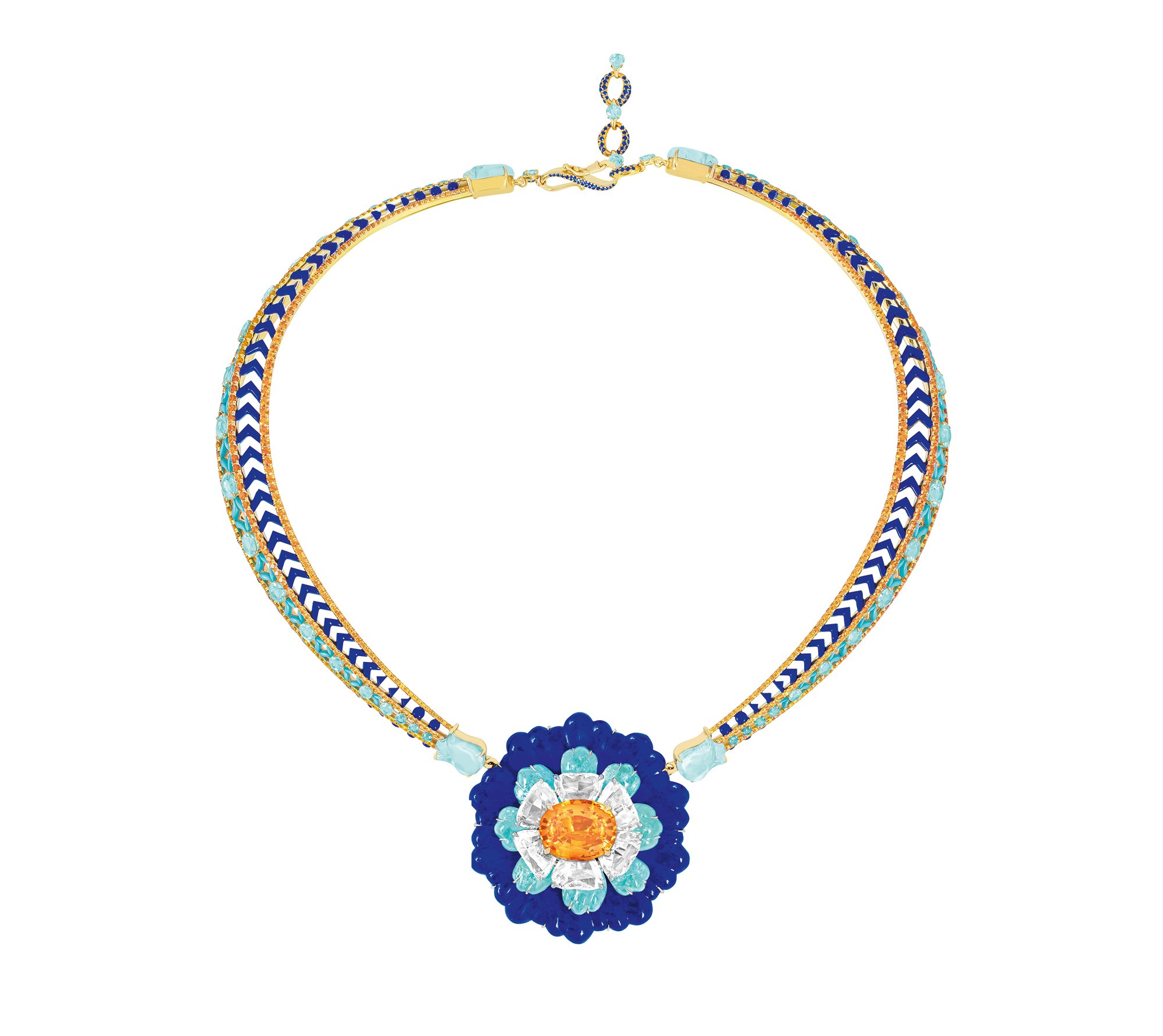
“It’s rare for a ’Fanta’ mandarin garnet to display this pure orange hue that leans neither towards yellow nor brown, and evokes the Indian festival of Holi,” Albert Boghossian continues. “We have paired it with blues that recall the sky and water.”
The challenge lies as much in the individual carving of the stones as in their assembly. Each element must find its place within a floral composition that appears to unfold naturally. The precision of the lapidary work gives the composition an almost lace-like, three-dimensional quality, in which the stones are no longer simply set but become integral parts of the design. “In this first collection, you can also see the Boghossian signature in these contrasts of colours and materials,” emphasises Albert Boghossian.
Atossa: the power of a cuff
With Atossa, queen of the Achaemenid Empire, the aesthetic shifts radically. Daughter of Cyrus the Great, wife of Darius I and mother of Xerxes I, she was a key figure in the Persian dynasty.
To evoke her authority, Albert Boghossian describes how “we wanted to create a bracelet that would reflect this woman’s power, not unlike Wonder Woman’s cuff. We drew inspiration from the motifs on a silver bowl discovered during archaeological excavations.”

The piece combines lapis lazuli, aquamarines, morganites, carnelian and diamonds in a geometric composition featuring bold colours. The aquamarines, cut into kite shapes, are set within the lapis lazuli. The pink and orange stones contrast with the intensity of the blue, while triangular diamonds emphasise the lines of the composition.
This design highlights one of Boghossian’s specialities: the art of inlaying stones into other stones, a technique that brings contrasting colours together while minimising the visible metalwork.
Theodora, a mosaic of precious stones
In the sixth century, Theodora, wife of Emperor Justinian I, wielded considerable political influence in Constantinople: she is particularly associated with legal reforms under Justinian that strengthened certain rights and protections afforded to women. Her image remains associated with the famous mosaics of the Basilica of San Vitale in Ravenna, where she is depicted surrounded by her court, adorned with jewellery and pearls. It is from this world that Boghossian drew inspiration.
The necklace, accompanied by asymmetrical earrings, echoes the opulence of Byzantine compositions. Emeralds, sapphires, spinels and natural pearls interplay in a colourful arrangement in which each element seems to form part of a mosaic. “At the centre, we have chosen a stunning Colombian emerald and a beautiful spinel from Tajikistan, both certified as having no clarity enhancements, as well as a sapphire. In order to stay true to the period, we have favoured cuts that evoke the cabochon rather than modern cuts. The cutting techniques of that period were not the same as they are today. We wanted to give the piece an antique feel, while creating a contemporary design.”
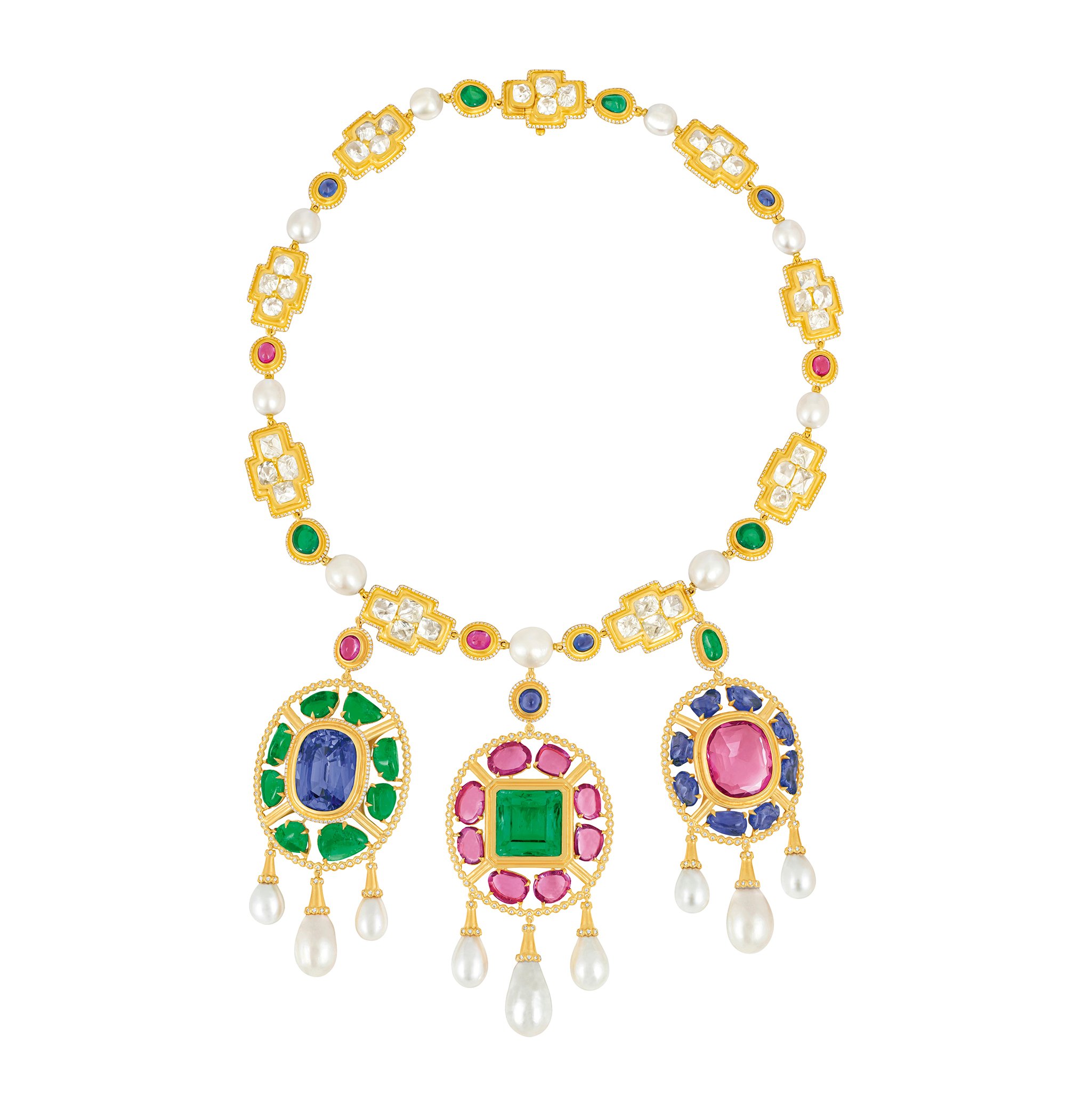
The house has also used sawn rough diamonds, whose pyramidal shapes are reminiscent of antique stones. Tiny diamonds, some measuring barely 0.6 millimetre, complete the filigree setting. This attention to detail is essential to appreciating the jewellery. The pearls add a touch of softness, the coloured stones form patterns and the diamonds punctuate the composition with light. The result possesses something of the sumptuousness of Byzantine mosaics.
Beauty before power
More space would be needed to discuss further the jewellery sets dedicated to Cleopatra (see pages 74-75), Joséphine de Beauharnais, Elizabeth I, Catherine the Great, Mumtaz Mahal, Seondeok, or even Indradevi, the twelfth-century queen of the Khmer Empire, for whom Boghossian created two sets inspired by Cambodian temple sculptures. One of these, a spectacular piece, combines Paraíba tourmalines from Mozambique, tanzanites, turquoises, diamonds specially cut into a tulip shape, and hauyne, a stone of an intense Klein blue. “As soon as I saw this stone at a dealer’s, I was amazed by its colour and bought it straight away. It is undoubtedly the most important piece of jewellery in the collection,” remarks Albert Boghossian.

When asked about the power he would like to convey to the women who wear his creations, he replies without hesitation: “I want women to feel beautiful when wearing my jewellery. I want it to enhance their beauty without overwhelming them.”


