



dler was established in 1886 in Istanbul, then capital of the Ottoman Empire, by Jacques Adler, the paternal great-grandfather of the current CEO. After serving an apprenticeship as a goldsmith and jeweller in Vienna, Jacques set up business in Istanbul’s gold district, working from his bench at the back of a modest shop. “One day, a dissatisfied customer came into the shop, wishing to return a pearl necklace which [Jacques] had made. My great-grandfather took a pair of scissors, methodically snipped every link, dropped each pearl into a bag and invited the lady to leave. A reaction that couldn’t be further from the service Adler would go on to propose, rooted in an Eastern tradition of hospitality,” remarks Allen Adler, highlighting his great-grandfather’s fiery temperament.

East meets West
This exposure to everything Istanbul had to offer in terms of aesthetic and multicultural inspirations would be the foundation for Adler’s style. More than a city, this was a world built on layer upon layer of civilisation, where Ottoman, Byzantine, Roman and Hittite vestiges beckoned. “Generation after generation, these multiple influences made a profound impression on our family,” Allen Adler continues. “This fertile ground is still alive today, as is the early influence of Vienna, Art Deco and Art Nouveau.” Adler’s jewellery appealed as much to the aristocratic families of the Ottoman Empire as it did to an international clientele—Russians in particular, both before and after the Revolution—and to the Levantine Christians living in Istanbul, many of Genoese and Venetian origin. Indeed, this ability to embrace multiple civilisations remains the hallmark of Adler jewellery today.

Unexpected consequences
Jacques’ son Edouard joined the company in 1937, shortly before his father died, and continued to grow the family business, bringing sons Franklin and Carlo into the fold at the first opportunity. Adler’s reputation spread, buoyed by a cosmopolitan clientele, in particular guests at the city’s Hilton hotel. However, one pivotal event would alter the course of the family’s history: in 1964, as Greeks and Turks fought over Cyprus, Edouard and his wife took the decision to leave Turkey. They left the Istanbul shop in the care of Franklin, Allen’s father, and, having obtained Greek nationality, moved to Athens where in 1966 they opened a new workshop. The Adler style retained its blend of influences, more overtly Ottoman in Turkey; more distinctly influenced by classical civilisation in Greece.


The move to Geneva
Franklin and his wife Leylâ continued to manage the Istanbul boutique until 1972, when they decided to join Carlo, Franklin’s brother, who now lived in Switzerland. The move to Geneva, one of the world capitals of jewellery, would prove decisive. Shortly after, the family opened a jewellery shop in an arcade on Rue du Rhône.
Carlo, Allen Adler’s uncle, recalls how “when we opened on the world-famous Rue du Rhône, a lot of people thought we wouldn’t last six months. They called us the ‘bazaar boys’. Yet more than fifty years later, here we are. We were fortunate to have the support of our father, in Athens. For example, a princess ordered thirty parures, all for the next day. With our father’s help we were able to fulfil the order within a record six weeks.” Clearly, the Adlers are a family whose resilience has been forged through challenges such as this.

The Geneva boutique prospered amid the growing wave of international visitors to the city, and equally thanks to the family’s engaging manner and sense of service. One of the anecdotes Allen Adler shared is particularly telling: “One Saturday afternoon in the late 1970s, staff were getting ready to close up when a gentleman entered, flanked by bodyguards. Every other jeweller had turned him away but my parents, having no idea who he was, welcomed him. He stayed from half past four until half past eight… and bought almost every item of jewellery we had. In fact we had to close the shop for the next three or four days until fresh pieces arrived. Later, my parents learned that he was a high-ranking dignitary from the Kingdom of Saudi Arabia. Thanks to this, Adler became known throughout the Persian Gulf.” This notion of attentive service remains ingrained in Adler’s identity, whether at the family’s boutiques in Geneva and Gstaad, or at its partners in Dubai, Abu Dhabi and Doha.
Creative serendipity
But what of the jewels themselves? What defines them and how do they come into being? Daisy Adler, Allen’s wife, answers with a single word: “Serendipity. There are no executive meetings, no marketing brainstorms. We simply let our creativity go to work.” Often, this begins with a deep dive into what the Adlers call the Magic Box: a box filled with precious stones that the creative mind can play with, experimenting with fresh combinations of colours and shapes.

Daisy Adler recalls her first steps in the business. “I was an intern and Leylâ [Allen’s mother] saw something in me that I had no idea existed. She handed me the Magic Box and I understood how much of the creative process occurs organically and the huge part spontaneity plays.” This same willingness to let creative juices flow no doubt explains the many bespoke creations, which grow out of long conversations between the jeweller and the customer. The fourth generation at the head of the firm fosters this organic approach, as Daisy Adler explains: “When we create a piece of jewellery, we welcome everyone’s ideas and opinions. Every piece of Adler jewellery is a baby nurtured by any one of the twenty people in our team.”
How would they define Adler’s style today? Allen and Daisy answer in unison: “From the very beginning, the mix of influences from East and West has been a fundamental element, although we enjoy putting our own twist on the classics.” In Allen’s words, “We want the ‘wow effect’ without the bling. We aim to surprise, not shock.” While early pieces were clearly marked by Eastern influences, from the 1970s and collaboration with Italian master goldsmith and jeweller Aurelio Balistreri, Adler refined its style in pieces that were more modern, as well as more exclusive. Full-fledged collections appeared, and with them the characteristics that are the hallmark of the brand. Adler’s style explores asymmetry, the sweep of a curve, always with the emphasis on simplicity and comfort. The recent Ballerina collection, where the flowing line of an arabesque accentuates movement, is the perfect illustration. Harmony is forged from asymmetry while freedom is captured in the absence of a clasp.
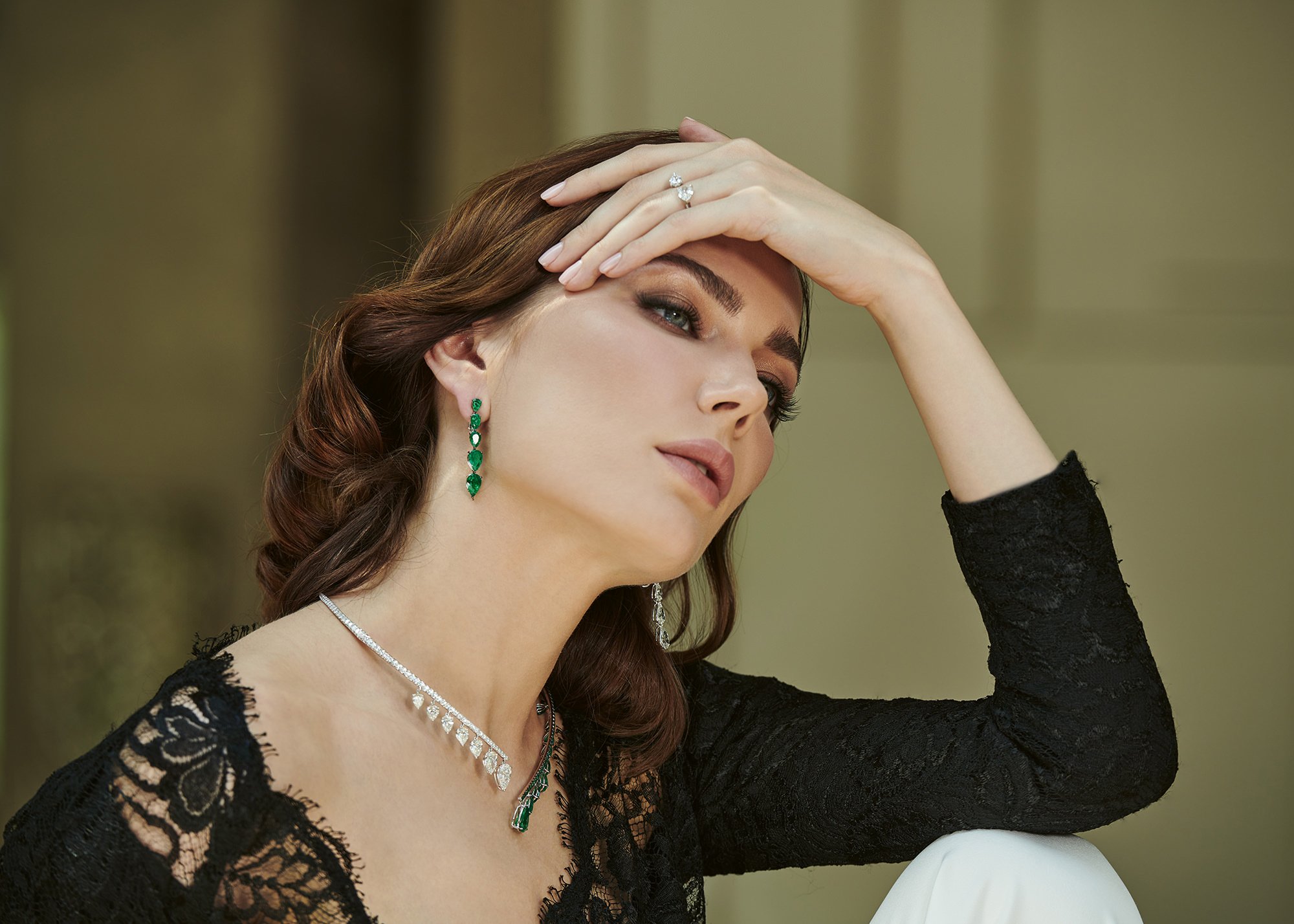
Certain themes and motifs appear across several collections in both high jewellery and jewellery. References to Art Deco and the fan shape are echoed in the Fan’tastic and Twirly jewellery collections, but also the Fan’tasia high jewellery collection. The rounded contours of flowers and leaves are suggested in the Evdokia high jewellery collection, inspired by the branches of the centuries-old olive trees of Corfu, and in the playful Water Lily jewellery collection in galvanised titanium. Eastern influences are never far away: the Shinsei collection interprets the delicate designs of Japanese kimonos in ingenious assemblies of articulated petals, initially in carbon, while Mistra, one of the jeweller’s newest collections, looks to the Byzantine Empire.

The generation at the helm feels no obligation to launch multiple collections each year, nor keep to the spring-summer/autumn-winter calendar of couture. Bespoke is an important part of the offering, with an emphasis on jewellery rather than high jewellery so that more people have the chance to wear Adler. “We’re keen to bring Adler to a wider audience,” Daisy Adler tells us, adding that “as artisan jewellers, the tendency towards quiet jewellery is reflected in more understated designs.” Allen Adler confirms this, quoting “greater demand for pieces that are smaller, more wearable and often transformable.” The jeweller’s strategy to appeal to a younger clientele translates into offbeat advertising campaigns, and always that same determination, inherited through generations, to forge a personal relationship with customers.
The Adler way
Allen Adler explains this principle by quoting something his mother Leylâ used to say: “Never look down on anyone. Be curious, never judgemental; accepting, never unwelcoming. This has shaped who we are and underpins the deeply personal relations we maintain with our customers. We are the antithesis of the haughty, condescending attitude sometimes experienced in certain boutiques. Often, we serve customers who are the third or fourth generation of their family.” This philosophy—and the creative freedom that comes with it—no doubt explains pairings of precious stones with less familiar materials such as titanium, wood, jet and enamel.

Asked how they envisage the brand’s future, the couple’s answer is unequivocal: “Adler is built on human values that we intend to preserve. We’re convinced that true luxury is about people: our customers, our partners and our staff. Obviously we have to consider factors such as technology, with 3D printing and the spread of artificial intelligence, how to maintain our position among the big luxury groups, and the challenges of sustainability, but through proximity with our customers, the guidance we offer and values carried across generations, we feel confident we can achieve our goal.”
Adler epitomises as much a way of being—savoir-être—as a way of doing—savoir-faire, motivated by the desire to create jewellery that is beautiful, of course, harmonious, original and without excess, but most of all the need to carry on the relations that have shaped the company from its earliest days. Adler is a jeweller defined by human values.


